


 en
 ko

PRD [Percussion Rotary Drill Method]


- PRD Pile is a type of foundation supporting ground structures and is constructed when there is a Soil Bearing Value of the small diameter (ø 600 to 1000 mm) section compared to the RCD Pile.
- Pile applied in part to top-down or downward construction in the Full Top-Down method. Mostly used as a Temporary Column considering the load of the basement layer.
- PRD Pile is a method of releasing excavated earth by hitting and rotating it into compressed air using Hammer Bit mounted on the Pile Drive.
Features
| It is able to construct to the soft rock layer or hard rock layer. |
| Construction speed is fast. |

RCD [Reverse Circulation Drill Method]
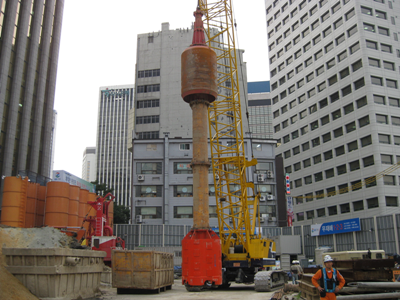
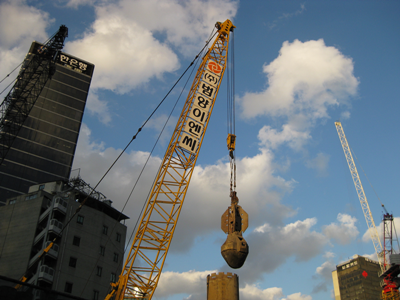
- RCD (Reverse Circulation Drill) method is to install Stand Pipe from the surface of the earth to the upper region of weathered rock. It prevents collapse of hollow wall, and it excavates with Hammer Grab. It is the construction method that excavates rock formation below to the design depth by rotating special Bit having maintained hollow wall with hydrostatic pressure more than 0.2kg/㎠ using either clear water or stabilizer.
- Excavate material generated during the excavation discharges above the ground together with circulation water through Drill Rod Pipe making use of compressed air from the lower part, and after settling the excavation material at the settling reservoir, it supplies settled excavation material again. By means of this method, it is called reverse circulation excavation method.
- Generally, RCD foundation is possible to excavate with the large-diameter drilled shaft from 1500mm to 3000mm. It’s the basic pile that support structures on the ground, thus it apply to the foundation of building or pier foundation of bridges.
Features
| It is able to construct to the soft rock layer or hard rock layer. |
| In the On Site Concreting Pile Methods, it’s the most large-diameter drilled shaft. |
| This is a construction method that uses water, so it’s possible to construct on the water. |
| There is a difficulty in management of straightness. |
| Constructions have difficulty in terrain conditions which cannot be maintained water level. |
Barrette Pile


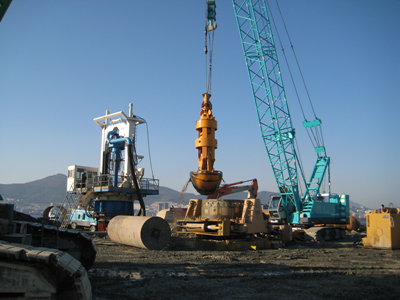
- Barrette Pile is, different from RCD Pile that is constructed as in circular section, and also is foundation pile supporting the structures on land, a kind of concrete pile on site concreting that is able to construct in various types of section which is necessary for secure the soil or ground bearing power.
- Construction method will, as in construction of slurry wall with rotating excavator like HYDROFRAISE, excavate to the designed depth maintaining a hollow wall having used Bentonite stabilizer liquid, and after installation of steel members, it will be concreting till completion of the construction job.
- Barrette Pile’s cross section can be expanded over 7㎡ in order to resist horizontal and vertical loads, and depending on geological condition, it can construct deeply under the ground, depth over 60m in case the stratum where brittle terrain had been developed, and it is also possible to construct up to the soft rock layer.
- A representative cross section is rectangular shape, but applied deformations, e.g. cross-shaped, and H-shaped, etc. is also possible.
Features
| Deep construction is possible to excavate to the soft ground. |
| Construction is possible with the desired section size, such as rectangle, H type, and cross type. |
| Low noise, no vibration technique. |
| Compared to RCD Pile construction, verticality is easier to manage. |
| Casing is not required because it is excavated in Bentonite liquid. |
Micro Pile
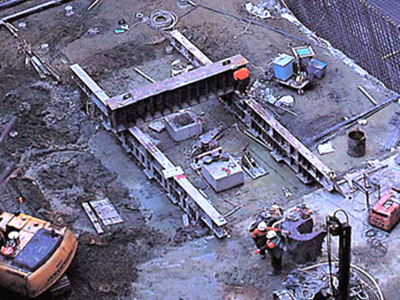
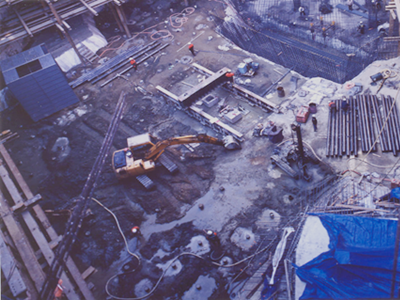
- Micro Pile is a small diameter file of 300mm or less that carries most of the load by the peripheral friction force of Pile.
- According to the construction purpose, the structure is classified as bearing file, Soil reinforcement file, and tension file.
- In addition, it can be tilted according to the purpose of Pile. Micro Pile formed by grouting may have a permissible load of up to or greater than 200 tons.
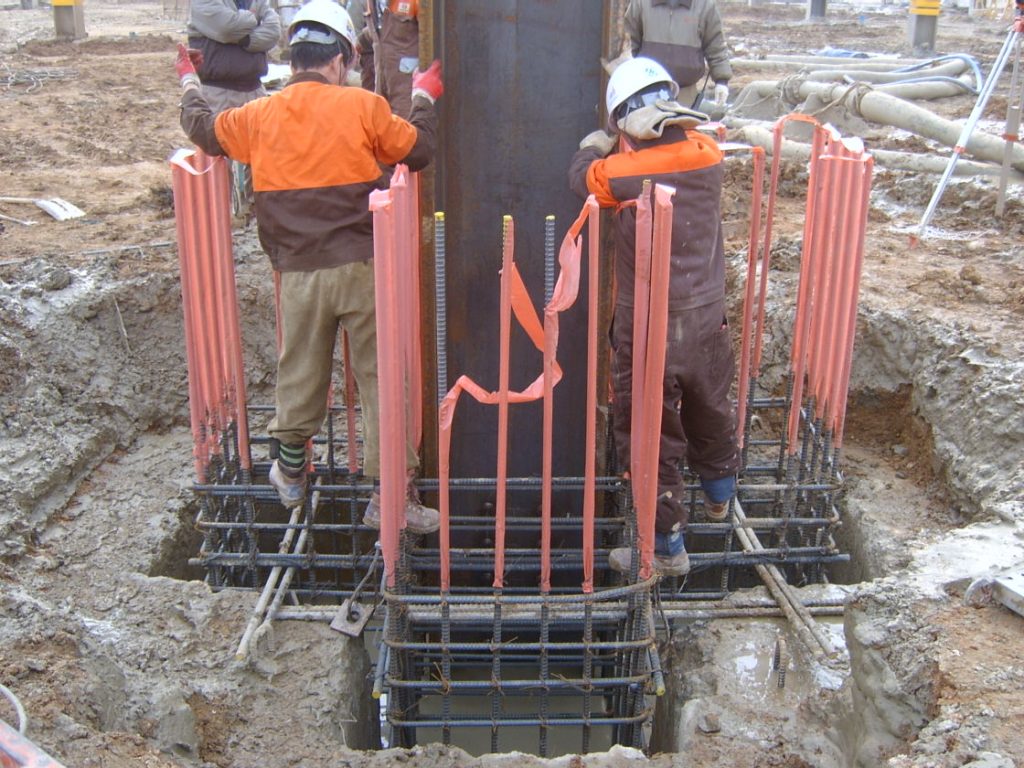
- After drilling, insert Pile objects such as reinforcing steel bundles or steel pipes, and inject cement as the main material. Then, insert a T.A.M. tube or steel tube in the center of the rebar bundle to perform pressure grouting.
- It is being developed and used as I.M Pile (Injection Micro Pile), an improved construction method that can achieve simultaneous effects of Pile construction and ground reinforcement.
Advantages
| Reinforcement (reinforcing bar or steel pipe) can resist large bending moment despite its small cross-sectional area. |
| Micro Pile can resist tensile and pull-out loads, so it can act as an anchor, and can be effective even when compression and pull-out loads work alternately. |
| It can work at any angle with a small cross-section, and it can be installed with small, light and compact equipment. In particular, it is effective even when existing equipment cannot be used within a limited space, and the cost of putting in and removing equipment is low. |
| It minimizes noise, vibration, and dust during pile construction, including drilling and grouting. The perforation can be constructed in any stratum, and can cope with stratum interference and voids. In addition, pressure grouting has an effect of reinforcing the ground by increasing the ground shear strength of the proximal portion of the pile. |
